2025 was intended to mark a turning point for Nepal’s tourism sector. The government had framed it as a ‘Special Tourism Year’, under the broader ‘Visit Nepal Decade 2023-2033’ vision.
Instead, tourist arrivals remained subdued while the year also turned out to be a test of sectoral resilience.
Monthly tourist arrivals in 2024 and 2025
This year, tourist arrivals largely followed familiar seasonal patterns: surging in the spring months of March and April, dipping sharply in May, remaining subdued during the monsoon months of June and July, and rebounding during the festive and trekking season in October.
However, several events created notable disruption, but tourist arrivals recovered more quickly than predicted.
In September, a youth-led protest erupted across Nepal, coinciding with the start of peak season. What began as a demonstration escalated into two days of intense national unrest, causing extensive damage to public institutions, private businesses, and critical tourism infrastructure.
The events saw severe attacks on several prominent hotels. In Kathmandu, hotels were set on fire, with the Hilton Kathmandu destroyed and the Hyatt Regency sustaining severe damage that led to its closure. Multiple resorts and hotels in Pokhara sustained massive damage that forced temporary closure and operational disruption. Such large-scale targeting of the hospitality sector was unusual in Nepal’s political upheavals; in the past, hotels had faced difficulties, but never on this scale.
[Read here: “Mapping the damage after Nepal’s two-day protest and violence”]
As a result, tourist arrivals fell to 78,711 in September, a 18.26% decline year-on-year. But arrivals recovered in October with 128,443 arrivals, surpassing the previous year’s arrivals of 124,391.
Yet attacks on the hospitality sector cannot be underestimated. While these facilities can be rebuilt, foreign investors will exert caution. Between mid-January to mid-December, tourism projects secured foreign investment commitments amounting to NRs 155.26 billion. While only a small portion of these commitments were turning into actual investments in the past, the recent unrest is likely to further undermine the investors’ confidence.
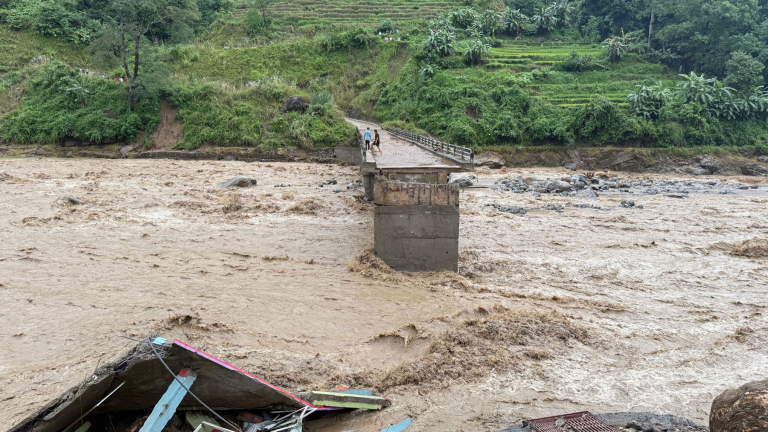
Another disruption was caused by an intense rainfall episode in early October. The downpour triggered floods and landslides across eastern and southern Nepal, leaving several roads and highways blocked. This event caused all domestic airports to remain closed, while diverting a few international flights to nearby airports.
[Read here: “Tallying the widespread impact of the October 2025 rainfall”]
Tourism source countries (2024-2025)
In 2025, Nepal welcomed 1.16 million international visitors, a modest increase of 0.95% over the previous year’s record. The arrivals until November are 97.3% of the pre-pandemic level in 2019.
The arrivals in 2025 are mostly led by India (292,438), the USA (112,316), and China (95,480), which together account for nearly 30% of the international visitors. Other notable countries include the UK (58,684), Bangladesh (57,545), and Australia (49,357). While India remained the single largest contributor, the steady inflow from Western countries helped maintain diversity in tourist arrivals.
Between mid-January to mid-November this year, Nepal has earned foreign exchange earnings of NRs 80.5 billion, a 7.17% increase from the previous year.
Policies, markets, and momentum
Nepal targets the Chinese market
Nepal began 2025 with a pivot toward China, launching ‘Visit Nepal 2025’ to coincide with the 70th anniversary of Nepal–China diplomatic relations. The campaign sought to revive Chinese tourist inflow, which once anchored Nepal’s tourism economy before the pandemic. In 2019, the country welcomed 169,543 visitors from China, which formed 14.2% of the total arrivals.
The pandemic triggered a sharp collapse in arrivals, just 6,198 in 2021. It rebounded to 60,878 in 2023, but the momentum remained uneven.
This year, Chinese tourist arrivals have reached 86,800, far below the reported target of 300,000 Chinese tourists.
Meanwhile, Nepal Airlines, the country’s national flag carrier, launched its direct flight to Guangzhou, China. The inaugural flight on October 16 carried 138 passengers, including 27 Nepalis, 29 Chinese, 61 Indians, and 11 others. Until 2008, Nepal Airlines operated flights to Osaka, Japan, with a stopover in Shanghai.
Additionally, Nepal welcomed 95,301 tourists from ASEAN countries, which marks an 8.4% increase over the previous year. These arrivals accounted for 8.9% of total tourist arrivals this year. Considering ASEAN as a long-term, high-potential market, NTB has announced 2026 as Nepal-ASEAN Tourism Year.
A new tourism policy was introduced
In August, the government unveiled Tourism Policy, 2025, replacing the 2008 framework, to reposition the country as a hub for adventure, culture, and wellness travel. The new policy emphasises sustainable and inclusive tourism, ensuring benefits reach marginalised regions and communities. Digital promotion and smart tourism tools are central to global outreach, while strong support for entrepreneurship aims to create jobs and strengthen local tourism businesses.
Nepal targets global remote workers with discourse on digital nomad visa
A high-level economic reform commission formed this year explored the Digital Nomad Visa through policy discourse. If adopted, the visa would allow working professionals to live, work, and invest in Nepal. Key features proposed under the recommended Digital Nomad Visa include:
Eligibility:
- Monthly income of $1,500+ or verified bank savings of $20,000+
- Work proof of remote employment outside Nepal
- Health insurance coverage of at least $10,000+ applicable in Nepali hospitals
Visa Benefits:
- Five-year multiple-entry visa
- Open a foreign currency bank account in Nepal
- Permission to buy and register vehicles; a foreign driving license recognised
- Income tax of only 5% (flat) for stays exceeding 183 days per year
- Visa holders may include spouses or partners
Upgradation of Tribhuvan International Airport (TIA)
Nepal’s key gateway for international visitors, TIA, is currently undergoing an upgrade, which aims to reduce air congestion while increasing the airport’s overall handling capacity.
Two new taxiways are currently under construction. The existing taxiway, located 110 meters from the runway, is being relocated 172.5 meters southwest, in line with International Civil Aviation Organization (ICAO) standards, and extended to 1,140 meters. Another 450-meter taxiway is under construction north of the runway.
Additionally, eight new exit taxiways are also being added to allow faster runway clearance after landing. The international apron is also being expanded northwards, increasing the aircraft parking capacity for larger aircraft from 11 to 18. Similarly, a new hangar apron to the east will include a dedicated taxiway to support aircraft maintenance operations.
TIA authorities closed the airport for 10 hours daily from November 8, 2024, to March 31, 2025, to facilitate capacity expansion work.
The upgradation is happening under the South Asian Sub-Regional Cooperation (SASEC) Airport Capacity Enhancement Project with a total project cost of $198 million, which includes $150 million concessional loan from the Asian Development Bank (ADB) and $48 million from the Government of Nepal (GoN).
The SASEC project also includes a new international terminal for Gautam Buddha International Airport (GBIA) featuring a solar-powered and energy-efficient system. This project is scheduled for completion by December 31, 2026.
NTB and UNDP launch $5 million sustainable tourism project
In March, NTB and the United Nations Development Programme (UNDP) launched a $5 million Sustainable Tourism Project to strengthen local tourism, create jobs, and enhance community livelihood.
The three-year project (2025–2028) is expected to generate 2,500 sustainable jobs and upskill 5,000 people through improvement in trekking trails, tourism facilities, and digital services.
Everest in focus
This year in September, Nepal revised its climbing permit fee for Everest and other peaks, the first revision made since 2015.
For foreign climbers, the new south route permit is $15,000 per person in the spring season, up from the previous $11,000. Similarly, the fees for the autumn season is raised to $7,500 from $5,500, and to $3,750 from $2,750 for winter and monsoon.
[In the autumn season (until 30th October), the Department of Tourism collected a total royalty of $30,000 from four climbers.]
For Nepali climbers, the spring seasonal permit nearly doubled from NRs 75,000 to NRs 150,000, as spring sees the most climbers.
Permit fees for international climbers on other peaks have also been raised. For mountains above 8,000 metres, spring season royalty has been raised from $1,800 to $3,000. The fee for the autumn season has been raised to $1,900 from $1,500. For winter and the monsoon, the fee will now be $750 from the previous $450.
Alongside this, Nepal has also unveiled its five-year Everest clean-up plan, namely the Everest Cleaning Action Plan (2025-2029), to tackle the mounting waste and environmental issues across the Himalayas.
The plan is to leverage technology like GPS, drones, and ropeways; deploy trained Mountain Rangers; enforce a “polluter pays” system; introduce non-refundable environmental fees; standardise waste management procedures; and use digital systems to track waste from source to disposal.
On the other hand, Nepal has removed permit fees for 97 peaks, ranging from 5,870 m to 7,132 m altitude, in Karnali and Sudurpaschim in the next two years. Officials hope this move will boost local economies and draw attention to Nepal’s lesser-known mountains.
$500 permit for upper Mustang trekking scrapped, sets $50 daily
This November, the government introduced a daily fee of $50 for individual foreign trekkers visiting Upper Mustang. Previously, tourists were required to obtain a 10-day permit costing $500, which has now been scrapped.
Ban on high-denomination Indian currency lifted
Nepal has lifted its long-standing ban on Indian notes above ₹100, following India’s approval. Travellers can now carry ₹200 and ₹500 notes up to ₹25,000 (≈NPR 40,000) across the border.
The move comes nearly a decade after Nepal banned higher-denomination notes following India’s 2016 demonetisation. The restriction had long caused inconvenience for tourists, migrant workers, students, and pilgrims, particularly in border towns, casinos, and remote trekking areas.
Officials expect the change to ease cross-border travel and spending, complementing digital payments in urban areas, and support tourism and local businesses dependent on Indian visitors.
Way forward: Plan for 2026
The vision for the tourism sector is still encapsulated in “Visit Nepal Decade 2023-2033”, a ten-year plan to revitalise the nation’s tourism post-pandemic. This plan aims to attract over 3.5 million international visitors, boost daily spending to $125, create one million direct jobs in the tourism sector, and enhance the sector’s contribution to national GDP to 10%.
Alongside this, Nepal’s 16th plan also set an interim benchmark for 2028/29: welcome over 2.5 million international visitors, extend their average length of stay to 15 days, raise average daily spending to $85, and increase tourism’s share of GDP to 7%.
The current growth patterns, however, show that the targets may be too ambitious.
Nevertheless, the ten-year plan remains in the Phase 2 stage, focusing on marketing initiatives and infrastructural enhancement.
To this end, the Nepal Tourism Board (NTB) announced a budget of NRs 1.59 billion for FY 2025/26, with around 70% of the budget allocated to global promotion.
NTB budget allocation (FY 2082/83) (In NRs million)
The focus is on the international trade fair, sales mission, digital campaigns, cinema tourism, diaspora programs, and the establishment of an NTB office in India — all designed to amplify Nepal’s presence in Europe, America, India, China, Japan, Thailand, Malaysia, and Vietnam.
Several initiatives mentioned in the budget have already begun, such as Nepal’s promotional partnership with TikTok, Nepal as a potential destination for Meeting, Incentives, Conferences, and Exhibitions (MICE), and participation in the Pacific Asia Travel Association (PATA) travel mart in Thailand.
These ongoing initiatives will continue alongside the full implementation of the Trekkers’ Information Management System (TIMS), the establishment of a Disaster Response Fund, climate resilience programs, and environmental awareness campaigns.