NRB publishes AI framework for banks; requests input
Nepal Rastra Bank (NRB) has released a draft of Artificial Intelligence (AI) guidelines for the financial sector, aiming to promote responsible and ethical adoption of AI technologies among licensed institutions, Payment System Operators (PSOs), and Payment Service Providers (PSPs).
The framework responds to the rapid growth of AI development, spanning from automated credit scoring to fraud detection, while addressing rising concerns over bias, data misuse, and system vulnerabilities.
Key points in NRB AI guidelines:
| Scope of Application: All NRB-licensed institutions: commercial banks, development banks, finance companies, microfinance institutions, Nepal Infrastructure Bank, Payment System Operators (PSOs), and Payment Service Providers (PSPs). Governance and Accountability: Boards are responsible for AI adoption, ethical standards, and governance structure for all AI-related activities. Senior management must ensure that AI systems are properly implemented, monitored, explainable, and compliant with NRB regulations. Risk governance standards: AI systems assessment for high-risk features, such as potential harm, large-scale impact, limited oversight, risk of rights violation, sensitive data use, and embed these risks into their core risk management framework with clear ownership and regular reviews. Transparency: Ensure that AI systems are transparent and explainable, with clearly labeled AI-generated content and decisions that shareholders can understand. Detailed audit trails must also be maintained in accordance with ISO/IEC 42001 — an international standard for AI management — while retaining them as required for regulatory oversight. Privacy and protection: Protect customers’ data under the Privacy Act, 2075 (2018). Collect only necessary data. Obtain consent before using their data in an AI system. Bias mitigation: Identify and mitigate AI biases, test systems regularly, and use third-party validation to ensure fairness and compliance. AI should be inclusive, serving all population segments, avoiding financial exclusion and inequality. Monitor and oversight: Continuously track AI performance and customer impact, prioritising frequent reviews for high risks and reassessment after major changes.All AI-related incidents must be reported to NRB with a clear impact analysis and corrective actions. With quarterly documentation of minor issues.Financial institutions must submit annual reports on AI systems, applications, risk management, and customer outcomes, making full documentation of audit and compliance. Capacity building: Boards, management, and staff must receive ongoing training on AI risks, emerging tech, and regulations to ensure competent governance and oversight. Customer awareness and grievances: Clearly inform customers about AI usage and maintain effective mechanisms to resolve AI-driven complaints. Compliance: Financial institutions must adhere to:Cyber Resilience Guidelines, 2023,IT Guidelines, 2012, The Privacy Act, 2075 (2018) Other relevant laws or regulations issued by the regulatory or governing bodies |
TNA-I secures three new institutional investors
Following its conversion into a public limited company, True North Associates Invest (TNA-I), an investment arm of True North Associates (TNA), has onboarded leading insurance companies, Shikhar, Surya Jyoti, and Citizen Life, in an attempt to raise its paid-up capital to NRs one billion.
TNA-I is a permanent capital vehicle that invests in early business ventures with potential to scale. While sector agnostic, the firms prioritise tech-driven and disruptive ventures, with portfolios including Sajilo Sewa, Eminence Ways, Foodmandu, Alpine Import and Export, etc. Its parent company, TNA, is engaged in thought leadership and ecosystem building.
Through this capital influx, TNA-I is set to expand into high-growth sectors such as agro-processing, energy, technology, tourism and hospitality, and manufacturing, which aligns with emerging economic opportunities in Nepal.
Nepal terminates DTAA with Mauritius
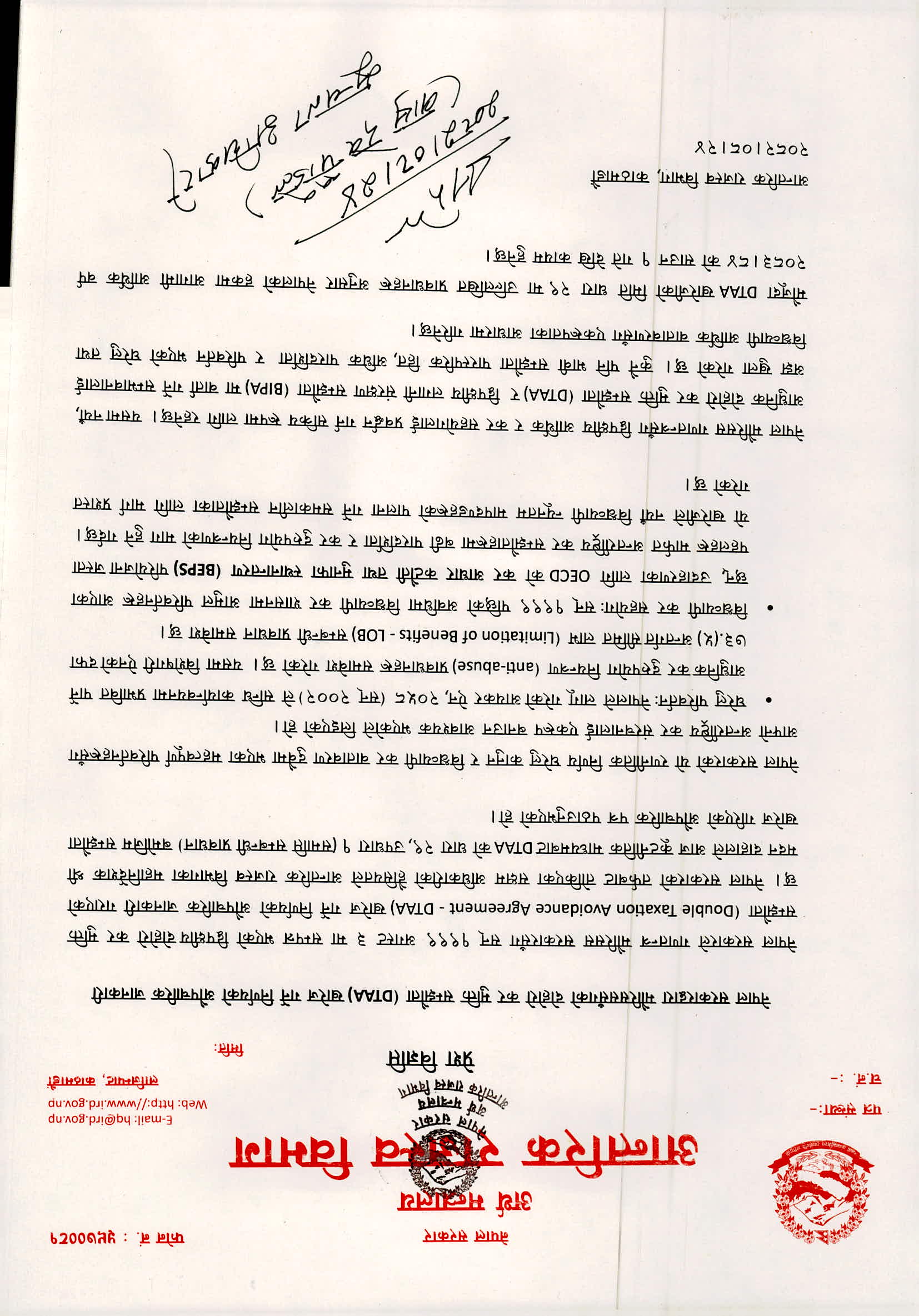
Nepal has officially severed its 26-year-old Double Taxation Avoidance Agreement (DTAA) with Mauritius. The Nepal government has terminated the 1999 agreement, formulated as an instrument to attract foreign capital, after finding it misaligned with Nepal’s domestic laws and the changing global conditions on curbing tax avoidance.
The treaty drew public attention recently when the government granted tax exemptions last month to Dolma Impact Fund, a Mauritius-registered entity, under the DTAA with Mauritius. Following this, the government decided to terminate the agreement with Mauritius and made an official statement, dispatching a formal notice to Mauritius under Article 29(1) of the treaty. The treaty will be void once this fiscal year ends.
According to the IRD, the DTAA, which predates Nepal’s Income Tax Act (2002), lacks safety nets such as Limitation of Benefit provisions marked under Section 73(5) of the act, which is designed to prevent the misuse of tax treaties by foreign-resident entities or shell companies that exist solely to allow offshore entities to claim tax benefits.
Similarly, global tax rules under OECD’s Base Erosion and Profit Shifting (BEPS) framework are demanding stronger transparency and strong anti-abuse measures to curb tax avoidance, states the department.
Government raises minimum support price; restores previous subsidy
The government has raised the minimum support price (MSP) for this season’s sugarcane to NRs 620 per quintal, up NRs 35 from last year, and restored the subsidy for farmers to NRs 70 per quintal after it was halved in July.
Introduced in 2018 to help farmers cover rising costs, the subsidy aims to support Nepal’s struggling sugarcane sector.
In August, sugarcane farmers from across the country came to Kathmandu to launch a series of protests to demand the government fulfil its commitments regarding crucial subsidies and long-overdue payments.
In July, the Ministry of Finance had decided to slash the sugarcane subsidy by half, from NRs 70 to NRs 35 per quintal, for the current fiscal year (2025/26).
During the same protests, the farmers called for an increase in the MSP from the existing NRs 585 per quintal to NRs 750 per quintal, which was to be finalised through a tripartite agreement between the farmers, the government, and sugar mills.
The area under sugarcane cultivation has steadily declined over the years, from 78,609 hectares in 2017/18 to 64,354 hectares in 2020/21, with production dropping from 3.67 million tonnes to 3.18 million tonnes. By 2022/23, it fell further to 61,771 hectares.
A 2023 study revealed that around 80% of growers are not paid fully or on time, underscoring persistent structural issues in the sector. The shrinking cultivation reflects a broader erosion of incentives, as sugarcane farming becomes increasingly unviable.
Nepal set to unban high-denomination Indian currency
After years of a ban on high-denomination Indian currency, Nepal is now set to lift the ban for notes above INR 100 following India’s formal approval. The Reserve Bank of India has already amended its Foreign Exchange Regulations, permitting the transport of higher-denomination notes across borders.
According to the amendment, individuals can carry notes above INR 100 amounting to up to INR 25,000 (NRs 40,000) across the border, while Nepalis may take up to NRs 5,000 to India.
India’s currency rules have evolved over the past decade, including the 2016 demonetisation of INR 500 and INR 1,000 notes, which led Nepal to ban notes above INR 100 in 2018. The latest developments emerged shortly after the NRB reiterated that only INR 100 notes are permitted for use or possession in Nepal, in accordance with the 2019 regulation prohibiting higher-denomination Indian currency notes, INR 200, INR 500, and INR 2,000, within the country.
The latest change is expected to improve cross-border travel and spending while easing long-standing structural issues caused by past restrictions for migrant workers, tourists, students, pilgrims, and medical visitors, who previously had to rely on low-denomination notes, exposing them to theft and legal trouble. The restriction affected tourism, particularly in border towns, casinos, and hospitality, as Indian visitors were unable to spend freely. Digital payments via QR codes have helped urban areas, but remote trekking and adventure destinations remain challenging due to poor connectivity.
Nepal allows tourists to bring up to USD 5,000 (or its equivalent) in cash into Nepal without needing to declare it at customs. This provision primarily applies to incoming tourists and Nepalis returning after an extended stay abroad, but does not extend to those who were traveling on tourist visas.